A trial of cryotherapy and hormone therapy for prostate cancer that has come back after radiotherapy (CROP)
This trial is looking at hormone therapy with or without cryotherapy for prostate cancer that has come back in your prostate gland after radiotherapy. This trial is funded by Cancer Research UK.
Doctors may treat prostate cancer that has not spread to other parts of the body with radiotherapy. But if the cancer comes back after radiotherapy, they are unsure of the best way to treat it. One type of treatment you may have in this situation is cryotherapy. Cryotherapy uses freezing probes to kill cancerous tissue.
But we don’t know yet if cryotherapy is better than other treatments such as hormone therapy. Researchers want to find out if there are long term benefits to having cryotherapy and how it affects your quality of life.
In this trial, the researchers are comparing hormone therapy alone to cryotherapy followed by hormone therapy. The men taking part don’t start having hormone therapy straight away. They are monitored to begin with and start hormone therapy when their blood level of a protein called PSA goes up. This is called deferred treatment.
The aims of the trial are to
- Find out how well cryotherapy before hormone therapy works for prostate cancer that has come back after radiotherapy
- Learn more about the side effects
Recruitment
Phase
Who can enter
You may be able to enter this trial if you
- Have prostate cancer that has come back in your prostate gland after radiotherapy
- Had either external radiotherapy or brachytherapy to treat prostate cancer that had not spread to another part of your body
- Have prostate cancer that is either completely inside the prostate or has grown no further than just breaking through the covering of the prostate (stage T3a)
- Have a PSA level of less than 20 ng/ml
- Have satisfactory results of other blood tests
- Are well enough to be up and about for at least half the day (performance status 0, 1 or 2)
- Are at least 18 years old
You cannot enter this trial if you
- Have any lymph nodes that are more than 1cm across when measured on an MRI scan
- Have had combined radiotherapy and brachytherapy to your prostate gland
- Have significant symptoms affecting the lower part of your urinary system including problems passing urine
- Have had an operation called a transurethral resection to remove part of your prostate gland and an ultrasound scan shows that this has caused a defect to the tube carrying urine out of the body from your bladder (the urethra)
- Had bad radiotherapy side effects caused by damage to your back passage (rectum)
- Have had hormone therapy for prostate cancer that came back after radiotherapy
- Have already had cryotherapy for prostate cancer
- Have blood clotting problems
- Have any other serious medical condition that the trial doctors think could affect you taking part
- Have had any other cancer and your doctors think there is more than about a 1 in 3 (30%) chance of it coming back within 5 years
Trial design
This phase 3 trial aims to recruit 540 men. It is a randomised trial. The men taking part are put into treatment groups by a computer. Neither you nor your doctor will be able to decide which group you are in.
- Group A have hormone therapy alone
- Group B have cryotherapy and hormone therapy
The trial team will ask you to fill out a questionnaire before you start treatment and then
- After 3 months, 6 months and 1 year
- Once a year after that
The questionnaires will ask about any side effects you have had and about how you have been feeling. This is called a quality of life study.
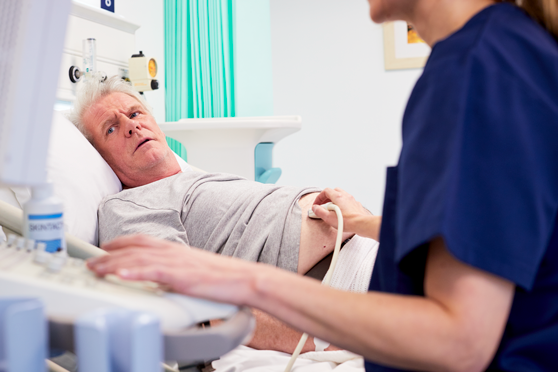
Cryotherapy freezes cancer cells. You have cryotherapy under general anaesthetic. It takes about 2 hours. Using an ultrasound scan, your surgeon guides needles through your skin into your prostate gland. Very cold temperatures are produced by channelling gas through the needles at high pressure.
The day before your cryotherapy you have 2 enemas to empty your back passage. After cryotherapy you may have some discomfort, but the trial team will give you painkillers if needed.
Men in both groups have hormone therapy. This is likely to start when the level of PSA in your blood rises above 20 ng/ml. Your doctor will talk to you about when to start hormone therapy and what the best treatment will be for you. This may be tablets, injections or surgery to remove your testicles (orchidectomy).
Hospital visits
You will see the trial team and have some tests before you start treatment. The tests include
You may need to have a biopsy if you have not already had one. Your doctor will take the biopsy during a transrectal ultrasound.
If you have cryotherapy, you may stay in hospital for 2 nights. When you go home, you will have a tube in your bladder to drain your urine into a bag. This is called a catheter. The catheter stays in place for about a week. Then you go back to hospital to have it taken out.
Men who have cryotherapy have another biopsy about 6 months later.
Everybody taking part will see the trial team after 3 months, 6 months and 1 year. After that you have a follow up appointment, bone scan and MRI scan once a year for up to 7 years.
You have PSA tests every 3 months for the first year and then once a year after that.
Side effects
The possible side effects of cryotherapy for prostate cancer include
- Urinary problems such as leaking or difficulty passing urine
- Problems getting an erection (impotence)
Rarely, cryotherapy to the prostate gland can cause a hole called a fistula to form between your bowel and the tube carrying urine out your body (your urethra). If this happens, you may have surgery to repair it. If you develop a fistula, it may be necessary to create an opening to the outside of your body (a stoma) which is covered with a bag.
The side effects of hormone therapy for prostate cancer include
- Impotence
- Loss of interest in sex (loss of libido)
- Hot flushes
- Swelling of breast tissue
- Memory problems
Location of trial
For more information
Cancer Research UK
Angel Building
407 St John Street
London
EC1V 4AD
Tel: 0808 800 4040
Email: cancer.info@cancer.org.uk
Please note: we cannot help you to join a specific trial. Unless we state otherwise in this trial summary, you must go through your own doctor.